


May 13, 2025
Sprinkled through a few prior editions, we offered a self-diagnosis of having “recession obsession,” which is easy to contract while in a role of deploying capital throughout markets.
Simply put, markets generally, and the stock market specifically, get roasted when it appears a recession is incoming, and if one is long enough, they continue to put on downside well into the recession.
In light of collective market participants’ obsession with a forward-looking view, markets are quite vulnerable prior to a recession if participants assess one is entering the near-term scene.
Said participants do not wait around for a plethora of data to be screaming that we are knee-deep in recession, but rather, they anticipate them and price asset markets according to the expected, incoming weak economic backdrop. Simply, they take shelter before the storm is evident.
With this, as part of our recession watch, we always look at a plethora of market-based trading behaviors from participants strewn across various markets. We consult their collective wisdom, their collective view, in order to help ascertain the probability of an incoming recession.
We particularly like and appreciate this collective view far more than you name it media outlet, business expert, college professor, Federal Reserve member, well, you get the point.
This, simply because said collective participants are in the business of deploying capital. Here, it is an endeavor of “get it wrong, you lose; get it right, you win game” with no do-over’s as the capital that is lost in the “get it wrong part” is lost. Lose enough and your capital deployment endeavor is no more.
This is compared to the aforementioned general list of intellectually based offerings of economic prognostications, whereby, if wrong, there is an inferred “oh shucks” with a simple moving on from there with their next prognostication. Rinse and repeat, time and again.
This takes us to an aspect of the stock market that we have shared in a prior edition, and we continue to be nearly amazed at the pricing behavior of this space.
The space represents payroll processors, which is an area that is quite vulnerable to recession. Bring on recession and, with it, reduced employment, leaving the payroll processors quite vulnerable in their primary business models.
We are somewhat amazed at their pricing behavior in light of the continual drumbeat, via our aforementioned general list of intellectual economic prognosticators, that an incoming recession is a near certainty. Perhaps it is.
As offered, we ourselves have recession obsession, which underlines our view that we remain open-minded to either outcome – recession or no recession.
What we find extremely interesting is how constructive this space has been trading throughout 2025 against said drumbeat backdrop that seemingly recession is a near certainty.
It is as though collective participants are offering a “yeah, whatever dude” type of reply when pricing this economically vulnerable area against the backdrop of intellectual expectations of an incoming recession.
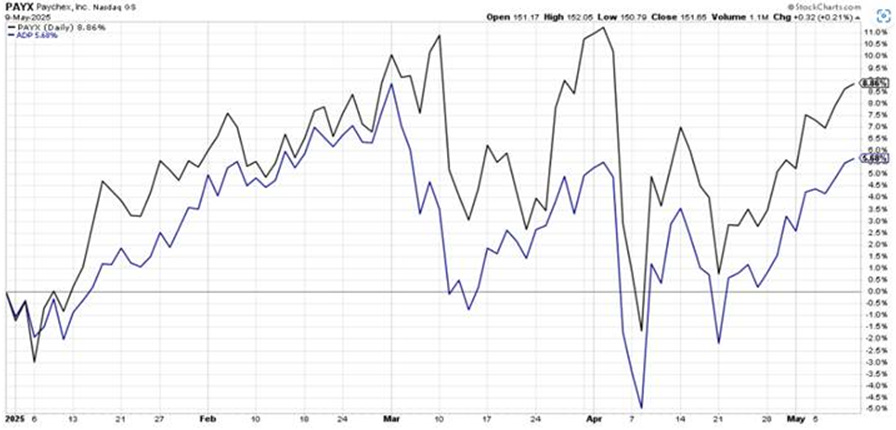
There are many ways to show trading behaviors when viewing a market or asset class. We thought using 2025’s year-to-date performance behavior of two multi-decade companies in this selected space would succinctly share their pricing characteristics.
Click For Larger View: https://schrts.co/WZYxxdcR
The two companies displayed above are Paychex (PAYX) and Automatic Data Processing (ADP), both of which have been public companies for decades. Human resource offerings is a general summation of their primary business models. As a space, they are typically referred to as payroll processors.
Importantly, we are using these two companies and this area of the stock market as tools for this edition. We are not suggesting that these companies should or should not be purchased or owned in portfolios. That topic is far outside of the purpose of this edition.
In viewing the two together in the above chart, we can see how they have spent the vast majority of this year in positive territory, to include up to the current day. With this, both have been outperforming the stock market all the way through 2025.
More interestingly, collective market participants have been unwilling to bid these two companies’ share prices to negative territory for any amount of time here in 2025.
At the worst of 2025’s stock market downturn, they dipped into negative territory but quickly regained positive ground. While each company has been treated a bit differently in the above year-to-date performance chart, both have generally carved out the same type of behavior.
While these two have been marginally and only briefly negative in 2025, the S&P 500 went as low as negative 15% while still remaining negative as of this writing. The NASDAQ Index went as low as 21% and also remains negative.
This places into some context the payroll processor’s pricing behavior here in 2025 to that of the overall stock market.
Behavior before a Recession
The above pricing behavior is not the behavior collective market participants display of these company share prices if they feel recession is imminently entering the broad economic landscape.
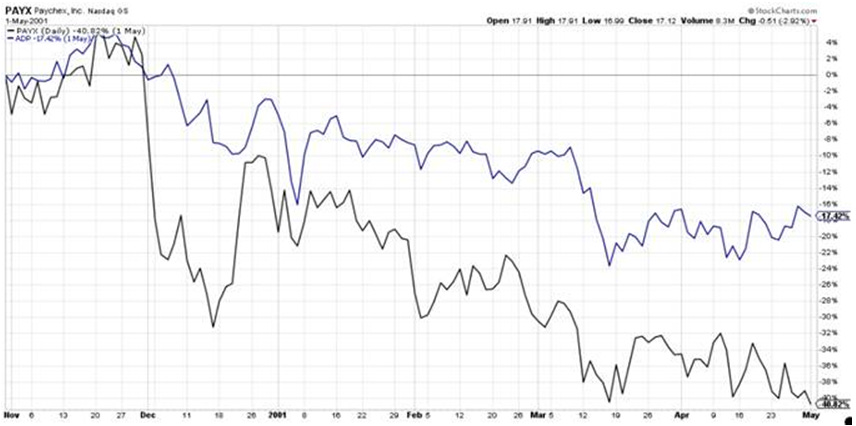
To draw a distinction between 2025’s pricing of these payroll processors and that of an incoming recession, we share a view (below) of the 2001 recession and how they were priced, via a performance chart dating back to latter 2000.
Again, it is important to keep in mind market participants are always forward-looking. With this, we look at their pricing behavior before the recession officially began and how they performed in the early stages of the recession.
At this juncture in our current economic landscape, we are not in a recession, but we are on recession watch, so we are focused on behavior prior to the official beginning of a recession.
Click For a Larger View: https://schrts.co/wkaZXEjG
The above performance chart dates back to November of 2000 through May of 2001. As the chart displays, collective market participants sent the above company share prices (PAYX and ADP) well into negative territory upon concluding a recession was imminent.
The actual recession began in March of 2001 and went on through November of 2001. Participants displayed no interest in waiting around for an official declaration that a recession had entered the scene and priced this asset category according to what they saw coming.
By the time the recession officially began in March of that year, participants had already priced these two companies down to heavy negative double-digit levels.
This takes us full circle to current day and the observation of this edition. As this juncture, per the above payroll processors’ pricing behavior, market participants continue to offer that they do not see an imminent recession. This is corroborated by many other market-based observations.
Importantly, this can all change quickly; hence our ongoing observation, as well as our occasional sharing of various market-based relationships within editions. To emphasize, per the above behaviors from collective participants, they are offering that recession is not imminent at this point in time.
I wish you well….
Ken from Mind Your Stops