


February 11, 2026
The bulk of our 2026 editions have addressed the structural shift within the stock market that began in mid-November of 2025 and then picked up in earnest as we crossed into 2026.
By the close of last week we had another indicator chime in on the developing shift to a broadening theme within the stock market.
The indicator is the long-standing stock market tool known as the Dow Theory.
Dow Theory offers that the stock market is offering a healthy general landscape when either the Dow Jones Industrial Average or the Dow Jones Transportation Average advances above a previous high point.
Importantly, once one of the two eclipses a previous high point, Dow Theory confirmation then arrives when the other joins in by advancing above a previous high point as well.
Keeping this simple, it is all about trend. A healthy market leaves in its wake a series of higher highs, i.e., a defined uptrend.
A truly healthy market, let’s say, a robust and strong, no-doubt-about-it bulled-up type market, will leave in its wake a series of higher highs across numerous well-recognized stock market indices.
We have been addressing this general topic relative to the stock market nearly anytime we have shared an edition on the stock market, in particular since the post-2022 market downturn.
As we have shared many times, post-2022, the stock market has not been robust and strong when viewed through a broader stock market lens.
It was a narrow market environment whereby a few handfuls of companies played an outsized role in pushing various market indices higher, most notably, the weighted version of the S&P 500. This is where some companies are weighted heavier than others in the construction of the weighted S&P 500 index.
This can give misleading signals relative to the overall health of the stock market at large, especially when the larger weighted companies are thriving handsomely. This has been the case post-2022.
Moving back to our central theme of Dow Theory, it too has offered the lack of a truly strong and solid bull market since the 2022 lows.
Again, to emphasize, we are speaking structurally here for the whole of the stock market, not about whether there have been X areas of the stock market that have offered performance opportunities.
Let’s take a look at messaging from collective stock market participants through the lens of Dow Theory.
Click For Larger View: https://schrts.co/IQYvnAxX
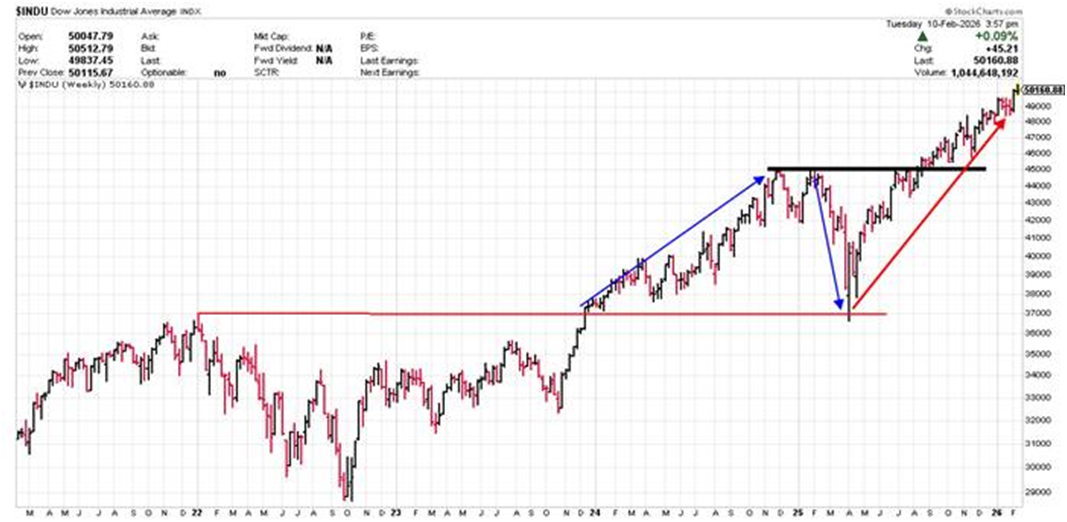
The above is a 5-year chart presented on a weekly basis for the Dow Jones Industrial Average. The 5-year view gives us some perspective on what has unfolded post-Covid. The weekly chart takes out a lot of daily trading noise, as each bar within the chart represents one full week.
The above can be viewed and thought of as the anatomy of a trend process over the previous 5 years.
We have inserted a few lines to aid in a visual understanding of what has been transpiring in this period of time.
Our red horizontal line begins as the post-Covid high point was put in, which morphed into the notable downturn in the stock market, circa 2022.
For its part, the Dow Jones Industrial Average bottomed in late 2022 and then struggled through 2023. Our blue arrow highlights the launch point of the Dow actually putting in a higher high by early 2024, which proceeded as a trend.
Our black horizontal line highlights the end point of the Dow’s trend at that time, which walked us into the notable drop of early 2025. The 2024 trend was erased rapidly in early 2025.
This takes us to current messaging from market participants.
As early 2025 turned to mid-2025, the Dow Jones was back to working its uptrend. This was confirmed as a new uptrend when it surpassed the black horizontal line, whereby, rather than being a price ceiling as it had previously, it became a price floor.
From there the Dow Jones Industrial Average continued to be on-trend as it posted higher highs, as highlighted by our red uptrend arrow.
This takes us to the Transportation Average.
Click For Larger View: https://schrts.co/gTZcRzvW
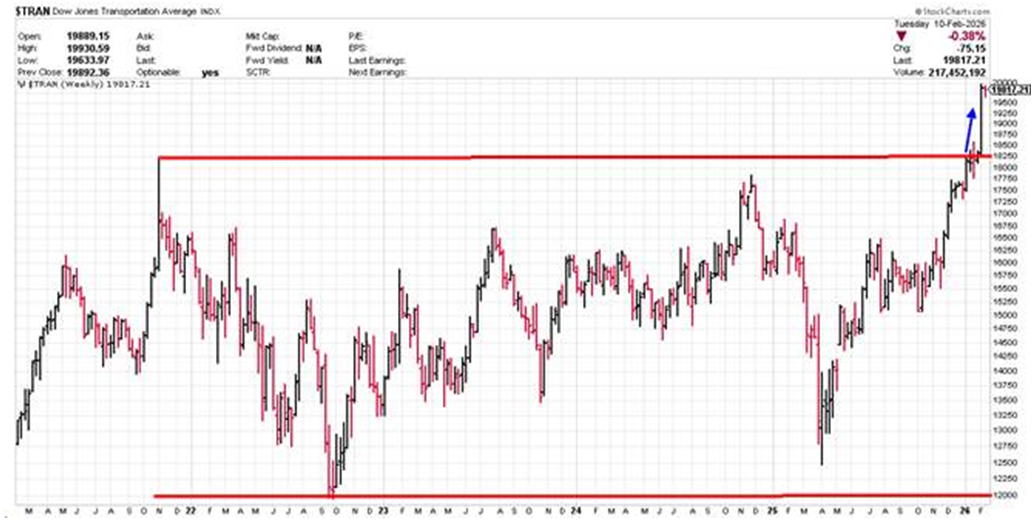
The above is also a 5-year weekly chart to match the layout of the previous Industrials chart.
Overall, the Transportation Average is more challenged than the Industrial Average. Post-Covid, the Transportation Average was posting a series of higher highs. As we entered 2022, the Transportation Average also turned south.
Unlike the Industrial Average, the above Transportation Average had been unable to put together any trend since the post-Covid uptrend, as it remained in a large price range. Our red horizontal lines highlight the large range from late 2021 up to last week.
By the end of last week, a notable shift in its pricing behavior occurred with a long-awaited new high breakout.
The Transportation Average had struggled for over four years, of which it had been trendless until last week’s close, which reflects a solid new high. This is a notable change in behavior, as it has ended four-plus years of struggling price behavior.
Dow Theory
Reduced to simplicity, Dow Theory is about trend and trend confirmation from a sidekick index.
Simply, one of the two indices needs to put in a higher high, i.e., an uptrend. Once established, the other index confirms the trend by also putting in a higher high, whereby its own new high trend has begun.
When both the Industrials and the Transports are trending, we have Dow Theory confirmation of a healthy, ongoing bull market.
In various editions over recent years we have addressed Dow Theory and the lack of a positive Dow Theory signal.
By the end of last week, for the first time in quite a while, we saw collective stock market participants continue with the broadening stock market storyline via an additional signal of structural strength with the above Dow Theory confirmation.
Does this offer stock market nirvana from here? No.
For our part at least, no one signal offers clear sailing for as far as the eye can see.
What this does offer is a change in behavior via the Dow Theory, which we have not seen in over 4 years. That is a notable change.
This, along with other behavioral changes, such as we have noted in recent editions, offers the stock market, structurally speaking, continues to broaden out in its participation, and, through this, improve its structural health to a degree we have not seen post-2022.
This is important messaging from collective stock market participants!
I wish you well...
-Ken from Mind Your Stops