


October 7, 2026
Back in 2023 we opened up a topic relative to interest rates where we shared that the multi-decade downtrend in rates had come to an end.
We shared this through the lens of identifying what can be thought of as a megatrend. Those are trends that remain in place for decades. They are so steadfast in their trend trajectory that few even question if it could be any other way.
With this, it becomes a societal expectation that crosses over generations in light of the large amount of time that such a trend encompasses. Megatrends become so pervasive that the topic itself doesn’t even register as a topic worth discussion.
In this case the interest rate megatrend fit the bill, and with this higher trending interest rates were no longer a topic worth discussing because everyone knew that rates would only hold steady or go lower. Guaranteed.
And therein lies the problem. When it comes to markets in particular, once the masses are convinced to the point of an expected guaranteed outcome, be prepared for a change.
So back in ’23 we opened our (new) interest rate megatrend watch.
As an aside, out of respect for the durability of megatrends, we waited over a year from the trend break before opening up the topic. Was this going to stick or be but a blip?
It then became clear it was not a blip, and so here we are continuing to watch what we view as the new megatrend, as we label it, while using history as our guide with such labeling.
A look at interest rate history
www.thechartstore.com
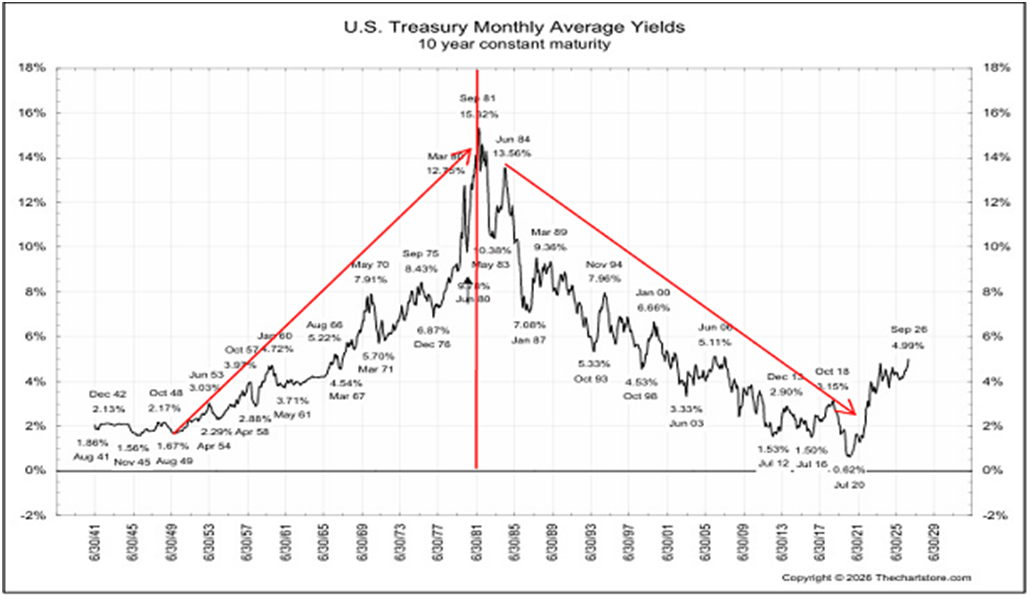
The above chart depicts the trend action of the U.S. 10-year treasury note over many decades. The 10-year is a benchmark interest rate that is set by bond market participants via their daily trading of these notes.
On the left side of the above chart, we begin in the early stages of WWII, circa 1941.
As our red uptrend line highlights, as the years and decades unfolded from that time up to the early 1980s, interest rates trended higher.
To be certain, like any trend, even megatrends are not without an ebb and flow as time rolls along. As we like to offer, no trend goes up or down in a straight line. This certainly held true back in the early 1940s and up through the decades that followed. Interest rates would ebb and flow while the uptrend remained solidly in place.
Time rolled into the early 1980s, and the well-entrenched societal expectation that interest rates would always be high or higher was challenged with the reality of a trend change. The old megatrend (higher rates) was obsolete, while the new megatrend of lower interest rates was in its infancy.
The early ‘80s give way to the early 2020s
Click for a Larger View: https://schrts.co/XWwNBKts
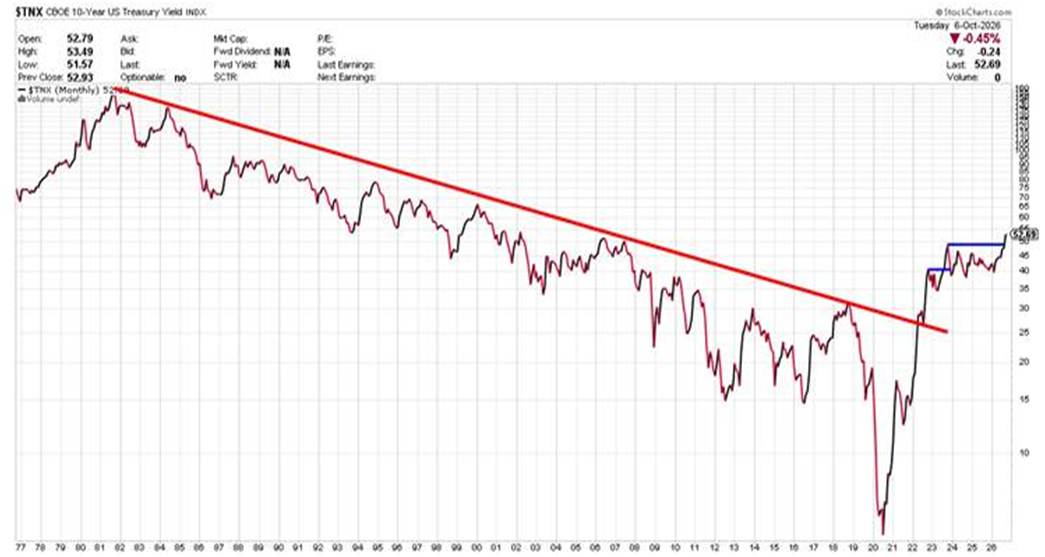
Our above chart isolates the more recent time of our initial chart to that of the latter 1970s up through the current day.
Here we focus on the multi-decade trend of low or lower interest rates from the early ‘80s up to the early 2020s.
Again, the ebb and flow within the megatrend is displayed above as interest rates would move higher only to then move lower, all while remaining within the established overall downtrend.
Since our initial edition on this change in megatrend, we have shared the above chart in a few follow-on editions. With this, we had inserted blue horizontal “watch lines” if you will, to monitor the behavior of this new trend.
Our top blue line denoted the high point of the new uptrend in interest rates. The line held for over two years while interest rates remained elevated and refused to move notably lower. They remained in a range, an elevated range.
We can see in recent weeks that bond market participants have pushed up the yield (think interest rate) on the above benchmark 10-year treasury note with seeming ease through our high point blue line.
This confirms this budding megatrend remains steadfastly in place with yet another higher high posted.
A series of higher highs defines an uptrend, and with this blue line breakout, we see continued confirmation this trend remains in place.
The Fed
An important note on the above is how irrelevant the Fed has become in the above storyline. That is mainstream media aside. For their part, seemingly, they still think the Fed is the all-powerful entity whereby what they dictate relative to interest rates is what will unfold.
If you think that this will all be fixed by the Fed, given time, we invite you to rethink this view.
The U.S. has $40 trillion in outstanding debt, an estimated $175 trillion in unfunded liabilities, and a price inflation backdrop that is systemically entrenched within the broad economic landscape, which has been in place for five-plus years.
The bond market’s response to the above brief synopsis is that higher interest rates are necessary irrespective of what the Fed thinks, or for that matter, what the broader D.C. officialdom thinks and/or desires.
The bond market is clearly in charge of the broad interest rate landscape.
As we shared in our previous edition, the bond market vigilantes, as they were called back in the 1970s, are resurrecting into the 2.0 version here in the 2020s.
For their part, current day, they are continuing to underline that higher rates are necessary as long as we continue with the runaway deficit spending and an entrenched price inflation backdrop.
To this point, we note that seemingly nobody within seats of authority in D.C., to include the wealth of candidates that are running for contested seats of authority with the upcoming midterm election, are offering any concerns relative to runaway deficit spending and the price inflation backdrop.
Historically speaking, what is known as the “national discussion” on topics of importance, in particular during election seasons, is seemingly void of these topics as urgent issues in need of solutions.
Rather, they are seemingly being treated as non-issues as reflected by their collective silence on these topics as they run to hold their seats or to replace current seat holders.
None of this is being lost on bond market participants, which speaks to how and why the bond vigilantes of the ‘70s are resurrecting to the 2.0 version in the current day. Per the trend, expect higher interest rates, given time.
I wish you well….
-Ken from Mind Your Stops